Call us today
+1 406 640 1748

By André & Michelle Blaauw, owners of Crisscross Namibia Safaris, Swakopmund
We have planned private safaris in Namibia since 2003, and the same questions land in our inbox week after week. Here are the honest answers — the ones we give our own guests before they book.
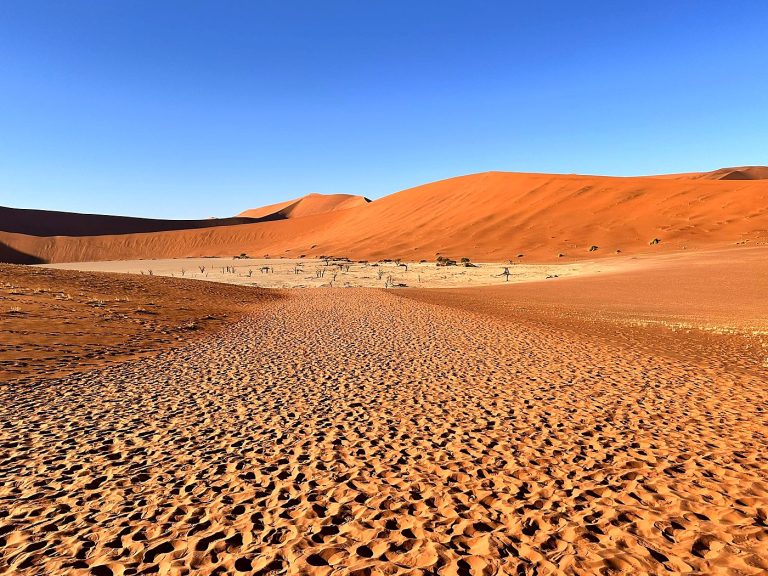
Ten to fourteen days is the sweet spot for a first Namibia safari. Namibia is a big country — roughly twice the size of California — and the famous places are far apart, so the trip needs room to breathe. With 10 to 12 days you can comfortably cover the classic circuit: the dunes of Sossusvlei, the coast at Swakopmund, the rocky wilderness of Damaraland and the wildlife of Etosha. Fourteen days lets you slow down, add the Skeleton Coast or a second area, and spend two or three nights in Etosha instead of one. Shorter trips can work if you focus on one or two areas or fly between them; longer ones — our safaris run from 4 to 24 days — open up the far north and combinations with Botswana and Victoria Falls.
For wildlife, the dry season from May to October is best: animals gather at Etosha’s waterholes, the grass is low and the days are mild. The green season (November to April) brings dramatic skies, newborn animals, superb birding and fewer visitors, but hotter days and the chance of rain. We have written a full month-by-month guide in our post on the best time to visit Namibia.
Yes — Namibia is one of Africa’s safest and most stable countries for travellers, with low rates of crime affecting tourists, especially on safari routes and in the lodges. The sensible precautions are the same as anywhere: don’t leave valuables visible in a parked car, use your lodge safe, and take care in towns after dark. The risk travellers actually underestimate is the road, not crime: long gravel distances, animals crossing at dawn and dusk, and fatigue. That is why every itinerary we build keeps driving to daylight hours.
Both work in Namibia, and the right answer depends on the trip you want. Self-driving gives you independence and is the cheaper route, and Namibia’s roads are well kept by African standards — but you do all the driving (and there is a lot of it), navigate, and spot wildlife with untrained eyes. On a privately guided safari, your guide drives, tracks, and interprets everything you see, the logistics are handled, and you simply watch the country go by; our post on why a private guided safari is a must-try explains what that changes in practice. Many of our guests do both: a guided private safari for the wildlife areas, with a few self-drive days around it. If it is your first safari and your time is limited, go guided — you will see far more.
Etosha is famous for lion, elephant and rhino gathering at its floodlit waterholes, and you will very likely see all three in the dry season, along with giraffe, zebra, springbok, oryx and much more. Leopard lives there too but is shy and mostly nocturnal — a sighting is a bonus, never a promise. Buffalo is the one Big Five member Etosha is not known for; your best chance of buffalo is further north-east in the Zambezi Region, or across the border in Botswana’s Chobe and Okavango — which is exactly why our longer safaris combine the two countries.
It depends mainly on your lodges, your season and whether you drive yourself, are privately guided, or fly in. To give you a real anchor: our own private guided 11-day Namibia safari starts from US$6,479 per person, and our 7-day luxury fly-in safari from US$16,310 per person. Our detailed breakdown of what a custom private safari costs explains where the money goes and what pushes a price up or down.
Quite possibly, yes — the rules changed recently. Since 1 April 2025, visitors from many countries that used to enter visa-free (including the USA, UK, Canada and most of the EU) need a visa, which you can apply for online through Namibia’s e-visa system or obtain on arrival, at N$1,600 (about US$90). Your passport must be valid for at least six months after your travel dates with blank pages to spare. Rules differ by passport, so check your own position before you fly — and we confirm the current position for every guest when we plan their trip.
Most of Namibia — the desert, the coast, Swakopmund, Sossusvlei and the south — is malaria-free or very low risk. The risk areas are in the far north (the Zambezi and Kavango regions, and parts of Kunene), mainly in the wetter months from November to May, and Etosha is considered low risk, rising slightly in the wet season. We recommend talking to your own doctor or a travel clinic about prophylaxis for your exact route and dates; whatever you decide, pack repellent and cover up at dusk.
For the classic circuit — Windhoek, Sossusvlei, Swakopmund, Damaraland and Etosha — a high-clearance vehicle handles the gravel roads well, and a 4×4 is strongly recommended rather than strictly required; it becomes essential for remote areas such as Kaokoland and the deep sand of the northern Skeleton Coast, and in the rainy season. If you self-drive, hire with two spare tyres, plan fuel stops carefully (stations can be hundreds of kilometres apart), and never pass fuel with less than half a tank in remote areas. On our guided safaris all of this is simply handled for you.
Longer than the map suggests. Typical legs on the classic circuit run 300 to 450 kilometres — three to five hours once gravel roads, fuel stops and photo stops are counted. Windhoek to Sossusvlei is about five hours; Etosha to Swakopmund most of a relaxed day with stops. This is why we build in two nights at most stops and never schedule driving after dark: the distances are part of Namibia’s magic, but only if the itinerary respects them. If long road days are not for you, a fly-in safari covers the same country from the air.
Less than you think, in a soft bag, with layers for cold desert mornings and warm afternoons. Our complete packing list for a safari in Namibia covers clothing, camera gear and the small things guests always wish they had brought. Two essentials wherever you go: a Type M (South African three-round-pin) plug adapter for Namibia’s 220V sockets, and a good hat — the desert sun is strong all year round.
For travel in the dry season (May to October), book nine to twelve months ahead if you can — the best small lodges in Etosha, Sossusvlei and Damaraland fill early, and a private safari is built around the specific rooms we can secure for you. Six months ahead is usually still workable, and the green season is more forgiving. Booking works simply with us: a 25% deposit secures your safari, with the balance due 60 days before you travel.
Still deciding? Tell us your dates, your days and what you dream of seeing, and we will sketch a route with honest advice — no obligation. Plan a Safari · WhatsApp us: +1 406 640 1748
Crisscross Namibia Safaris is a family-run, NTB-registered safari company and full member of TASA, based in Swakopmund, Namibia and the USA. Owners André & Michelle Blaauw have designed private, tailor-made safaris since 2003.
We are excited to help you personalize your next safari holiday and turn your dreams into memories.
Enquire NowThe owner, André Blaauw, was born and raised in Namibia and has a rich family history and connection to the land.
Our experienced and culturally diverse guides are Namibian born and raised.
André & Michelle are always available to consult with you at any time about your wants and needs via WhatsApp phone or video call, text message or email.
Tailor-made itineraries, accommodations and activities designed specifically for you.
Extensive safety protocols based on over 20 years of on the ground experience.